
Jasper County Court Records After a Jail Arrest
Once a person is arrested and booked in Jasper County, the case moves out of the sheriff's hands and toward the courthouse. The Jasper County State's Attorney reviews the arrest and decides what charges to file. When the prosecutor files a charging document, a criminal case opens in the Jasper County Circuit Court, and that case becomes the court record. From that point, the charges, hearings, and outcome are tracked by the court, not the jail report. This is the core idea of court records after an arrest: the arrest is the start, but the court record is where the charges live.
The booking side and the court side are different records. The jail report shows a custody charge label while a person is held, and the booking detail sits with the sheriff. For that side, see Jasper County jail inmate records for the roster and jail mugshots for booking photos. The court record, by contrast, is the charge the prosecutor filed and everything the case does after that. Keeping the arrest label and the filed charge separate is the key to reading these records well.
How to Find Jasper County Court Records After an Arrest
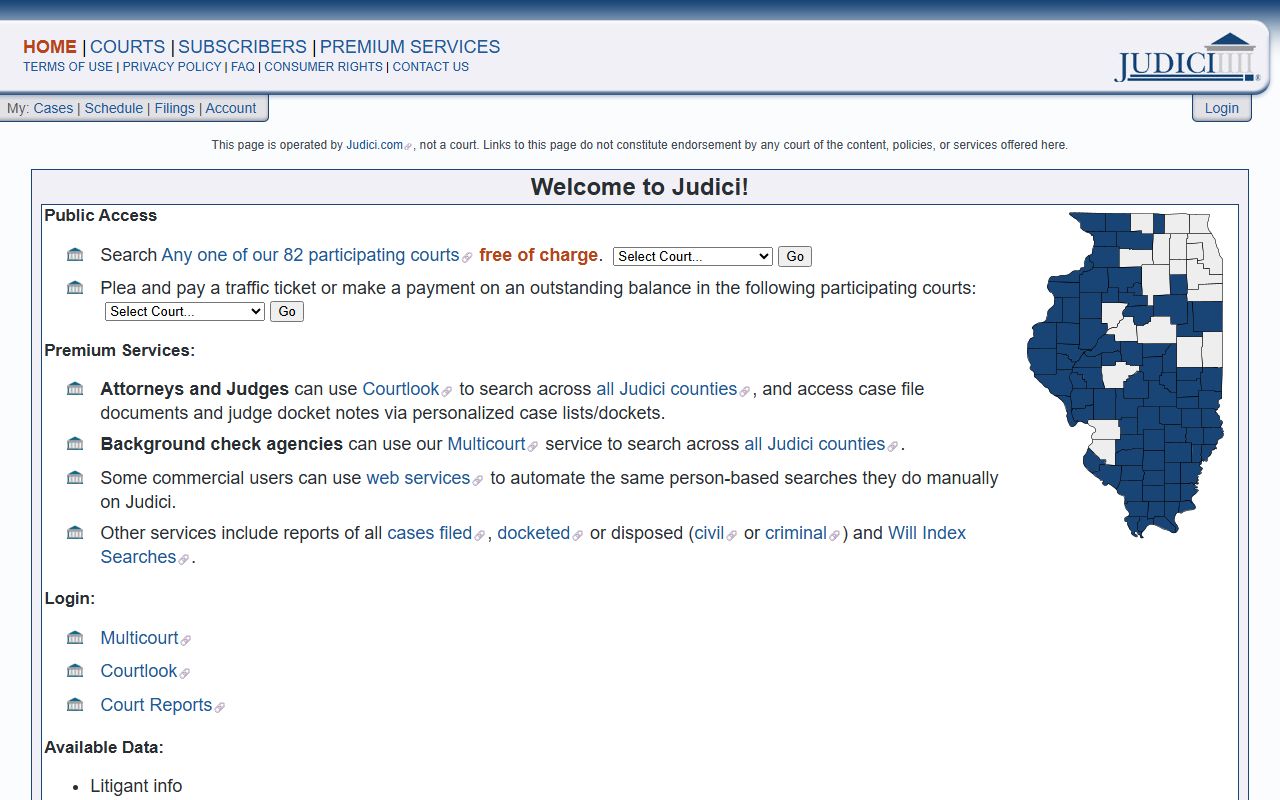
Court records for Jasper County are searched through Judici, the public online portal the county links for case access. Judici lists Jasper County among its participating courts and lets the public search free of charge. Arrest and booking detail stays on the jail side; the charges, dates, and outcome live in the court case. These steps find the court record.
- Open the Judici public access portal and choose Jasper County.
- Search by the defendant's name or a case number.
- Open the case and read the charge list the prosecutor filed.
- Check each charge's level and current status, then track the hearing dates.
The Judici portal, shown below, lists the kinds of case data the public can see, from charges and dispositions to fines, hearing dates, and case minutes.
The direct Jasper County case search can present a security check, so the case may take a step or two to reach. If Judici is gated, the Circuit Clerk can pull the court record by phone or in person.
Judici lists the kinds of data a case can show, including the litigant, the criminal charges, dispositions and sentences, fines and fees, hearing dates, and case minutes. For a record that reaches beyond a single county, the Illinois State Police keeps statewide conviction information under the Uniform Conviction Information Act, a separate process from a county case search. The portal itself notes that it is run by Judici.com, not by a court, so a link to it is not a court's endorsement of its content.
How Charges Get Filed After an Arrest
The court record opens with a charging document. Booking happens first at the jail, then the charge record begins when the prosecutor or a grand jury files the formal charge. Illinois uses three main types, and which one applies depends on the seriousness of the offense. A complaint or information is the common path for most cases, while serious felonies can run through a grand jury indictment.
| Complaint | Information | Indictment | |
|---|---|---|---|
| Filed By | Officer / Prosecutor | State's Attorney | Grand Jury |
| Common For | Misdemeanors | Many felonies | Serious felonies |
| Starts | The case | The case | The case |
The State's Attorney's office, James S. Treccia, handles these filings at the Jasper County Courthouse. The office reviews law-enforcement arrests and files charges where the evidence supports them, and it prosecutes the case in circuit court.
Charge Status in the Court Record
Charges are not fixed once they are filed. As a case moves, a charge can be amended, reduced, added, or dropped, and the booking charge on the jail report can differ from what the prosecutor finally files. The court record tracks these changes, which is why it is the reliable source for the current state of a case. The table defines the common status terms.
| Status | What It Means |
|---|---|
| Pending | The charge is filed and the case is still open and moving through court. |
| Amended / Reduced | The charge was changed, often to a different or lesser offense. |
| Dismissed | The charge ended without a conviction. |
| Nolle Prosequi | The prosecutor chose not to pursue the charge. |
Note: A jail report charge is a booking label, so always confirm the live charge and its status in the court case rather than the roster.
Release and Detention After an Arrest
Illinois no longer uses money bail as the standard way to decide release. Under Article 110 of the state's criminal procedure code, the law presumes a person is eligible for pre-trial release, usually on their own recognizance with conditions where needed. The prosecutor may ask the court to detain a person in eligible cases, and the court then applies the statutory standards. This is why the jail report's bond field reads as a status label, often "No Bond," rather than a cash amount to pay. The table sorts the old terms from the current Illinois practice.
| Bond Type | How It Works in Illinois |
|---|---|
| Cash Bond | Abolished as the standard pre-trial mechanism under state law. |
| Surety Bond | No longer the standard route; release turns on court findings, not payment. |
| Personal Recognizance | Release on a promise to appear and follow conditions. |
| No-Bond Hold | A detainer, warrant, or detention order can keep a person in custody. |
If a court orders detention, that authority shows in the court case and its orders, not just the jail report. Holds from other agencies, warrants, a Mittimus, or a DHS hold can also keep a person in custody even after one case is resolved.
Warrants That Lead to an Arrest
Many bookings start with a warrant. Jasper County has no public active-warrant search portal, so a warrant itself is not posted online. The sheriff's monthly arrest reports do document arrests on county warrants, failure-to-appear warrants, body attachment warrants, probation-violation warrants, and out-of-county warrants. To check on a warrant tied to a case, search Judici for the defendant or contact the Circuit Clerk for the court docket. For custody questions, call the sheriff's office at (618) 783-8477 or the jail at (618) 783-3462. If the warrant belongs to another county, contact that county's court or sheriff.
The arrest reports document several warrant types, and knowing them helps you read a case.
- Arrest warrant: a court order to take a person into custody.
- Bench warrant: issued by a judge, often for a failure to appear.
- Body attachment: used in certain civil or quasi-civil enforcement matters.
- Probation-violation warrant: tied to an alleged breach of probation.
- Out-of-county warrant: from another county, which may mean a hold pending transfer.
Charges vs. Convictions in Court Records
Being arrested and charged is not the same as being convicted. A charge is an accusation that opens the court record. A conviction is a court outcome, reached only by a plea or a verdict. A booking on the jail report cannot tell you whether a person was convicted, because that answer lives in the case disposition. The table draws the line.
| Charge | Conviction | |
|---|---|---|
| Stage | Accusation | Verdict or plea |
| Burden of Proof | Probable cause | Beyond a reasonable doubt |
| Public Record | Yes | Yes |
The sheriff's arrest reports say plainly that the statements rest on probable cause and that everyone is presumed innocent until proven guilty, which is the same principle in plainer words.
Sealed vs. Expunged Records After an Arrest
After a case ends, Illinois law lets eligible records be cleared from public view through the courts. Sealing hides a record from most public access, while expungement removes or destroys an eligible record. Eligibility depends on the case type, the disposition, and statutory limits under 20 ILCS 2630/5.2. The Illinois Courts and the Office of the State Appellate Defender publish the approved forms and general guidance. The table contrasts the two.
| Sealed | Expunged | |
|---|---|---|
| Visibility | Hidden from public view | Removed or destroyed; treated as if it never existed |
| Law Enforcement | Limited access remains | Very limited access |
| Eligibility | Set by case type and disposition under Illinois law | Often dismissals and eligible dispositions under Illinois law |
Court Records and Background Checks
A casual court-record lookup is not the same as a regulated background check. Formal background screening for jobs, housing, or credit must follow the federal Fair Credit Reporting Act and use a licensed consumer reporting agency. A free Judici search or this kind of reference page is for general information only and is not a screening service.
Important: This site is not a consumer reporting agency under the FCRA, and nothing here may be used for credit, employment, tenant, or insurance decisions.
Restricted Court Records After an Arrest in Jasper County
Not every record tied to an arrest is open. Juvenile cases are restricted, sealed or expunged charges drop out of public view, and a dismissed charge can be cleared through the court process. Records tied to an open investigation may be withheld, and the judicial branch follows court-record rules rather than the Freedom of Information Act. For that reason, a court record is requested through the Circuit Clerk and Judici, while sheriff records like booking reports go through the county FOIA process. The Jasper County Courthouse directory lists the court contacts for these requests.
The Jasper County Courthouse directory is shown below for the county's court contacts and location.
The Circuit Clerk, Jamie Blake, can be reached at (618) 783-2524 for docket and court-record questions the portal does not answer.